 Filed Under :
 Wednesday, May 26, 2010
The Sugar Glider (Petaurus breviceps) is a small gliding marsupial native to eastern and northern mainland Australia, New Guinea, and the Bismarck Archipelago, and introduced to Tasmania, Australia.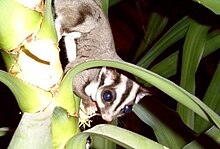
Habitat
Sugar gliders can be found all throughout Northern and Eastern Australia, along with the surrounding islands of Tasmania, Papua New Guinea, and Indonesia. They can be found in any forest where there is food supply but are commonly found in forests with eucalyptus trees. They are nocturnal, sleeping in their nests during the day and active at night. At night is when they hunt for insects and small vertebrates and feed on the sweet sap of certain species of eucalyptus, acacia and gum trees. The Sugar Glider is named for its preference for sweet foods and its ability to glide through the air, much like a flying squirrel.
When suitable habitats are present, sugar gliders can be seen 1 per 1,000 square meters provided that there are tree hollows available for shelter. They live in groups of up to seven adults, plus the current season's young, all sharing a nest and defending their territory, an example of helping at the nest. A dominant adult male will mark his territory and members of the group with saliva and a scent produced by separate glands on the forehead and chest. Intruders who lack the appropriate scent marking are expelled violently.
Appearance/Anatomy
A sugar glider has a squirrel-like body with a long non-prehensile tail. The males are larger than the females and their length from nose to tip of tail is about 9.5 to 12 inches long. They have a thick, soft fur coat that is usually a blue-grey; some have been known to be yellow, tan, or albino. A black stripe is seen from their nose to midway of their back. Their belly, throat, and chest are a cream color.
They have five digits on each foot, each having a claw, except for the opposable toe on the hindfeet. Also on the hindfeet the second and third digits are partially syndactylous (fused) together to form a grooming comb. Their most striking feature is the patagium, or membrane, that extends from the fifth finger to the first toe. When legs are stretched out this membrane allows them to glide distances 50-150 meters. Their gliding is regulated by changing the curvature of the membrane or moving the legs and tail.
Another feature are the scent glands, located on the frontal (forehead), sternal (chest), and paracloacal (cloaca). These are used for marking purposes mainly for the males.The frontal is easily seen on males, its a bald spot. The males also have a bifurcated (two shafts) penis. The females have a marsupium (pouch) in the middle of her abdomen to carry offspring.
Torpor
During the cold season, drought, or rainy nights a sugar gliders activity is reduced. This is usually seen due to torpor. In the winter season or drought there is a decrease in food supply, which is a challenge for this marsupial because of the energy cost for the maintenance of its metabolism, locomotion, and thermoregulation. With energetic constraints the sugar glider will enter into daily torpor for 2-23 hours while in rest phase. [13] However, before entering torpor a sugar glider will reduce activity and body temperature normality in order to lower energy expenditure and avoid torpor.
Torpor, which is seen as an emergency measure, allows the animal to save energy by allowing its body temperature to fall to a minimum of 10.4ºC. [16] to 19.6ºC [17] When the food is scarce, like in winter, heat production is lowered in order to reduce energy expenditure.With low energy and heat production it is important for the sugar glider to peak its body mass, by fat content, in autumn(May/June)in order to survive the following cold season. In the wild, sugar gliders enter into daily torpor more often than sugar gliders in captivity.
Diet and nutrition
Like many exotic animals, the Sugar Glider can suffer from calcium deficiencies if it isn't fed an adequate diet.Calcium to phosphorus ratios should be 2:1 to prevent hypocalcemia sometimes known as hind leg paralysis (HLP).
In the wild, gliders live off gum and sap (typically from the eucalyptus), acacia trees, nectar and pollen, manna and honeydew and a wide variety of insects and arachnids. A captive glider's diet is protein (mealworms and crickets, eggs, newborn mice, lean meat and commercial protein sources such as insectivore diets, monkey chow) and rest is made up of fruits, vegetables, sap, and nectar with additional calcium through things like yogurt and supplements.
As pets

Outside Australia, the Sugar Glider is a popular domestic pet because of its lively and inquisitive nature; with plenty of attention (a minimum of 1-2 hours of daily human interaction), it bonds well to human companions. Sugar Gliders are known as "pocket pets" because of their size and natural sociability. Although most vendors advertise the Sugar Glider as sociable the pet actually takes a long time to adapt to its human owner, and does not do well with other pets. Sugar Gliders are also known to be especially intelligent. Where legal, the Sugar Glider is not difficult to breed in captivity under the right conditions.
Sugar Gliders are defined by the USDA as:
Pocket pet: small, non-dangerous pet type mammal, such as, a flying squirrel, hedgehog, prairie dog, and sugar glider.
As of March 2009, they are legal to own as domestic house pets in the U.S.A in 46 of the 50 states,with Alaska, California, Hawaii and Massachusetts not allowing ownership. In Pennsylvania, they are only allowed to be kept as pets with a permit, but it is quite rare that a permit is issued. However, individual U.S. cities may prohibit the keeping of Sugar Gliders.They sell for a wide range of prices, depending upon the colour variation and the source.
0 comments:
Post a Comment